
By Quinn Martin | MCSquared Roofing
North Carolina doesn’t get hurricanes every year — but we get hurricane-grade wind gusts without the warning. A summer thunderstorm rolling off the Piedmont can hit 60 mph gusts, and the derecho-style straight-line wind events we see every few years flatten more fences than any named storm. If you’re putting up a fence in the Triad, wind and soil should drive the decision as much as the style.
Here’s what actually survives North Carolina weather, from the fences we install.
What fails first in a storm
Every fallen fence has the same autopsy: the post failed, not the pickets. Wind pushes the panel like a sail, and the post either snaps at the ground line or leans out of its hole. Three things decide which happens: post material, post depth, and the soil around it.
That’s why North Carolina clay matters. Our soil swells when wet and shrinks when dry, which works a concrete-set post loose over the years if the hole wasn’t dug right. A shallow post in clay is a fence with an expiration date — it’s just waiting for the storm that cashes it.
The fence types, ranked for storm survival
Aluminum fence: the storm champion
Aluminum panels are see-through — wind passes through instead of pushing them. No sail effect, no rot, no warp, and most aluminum fence is rated for 100+ mph exposure. It’s why you see aluminum around pool code where failure isn’t an option. Trade-off: it doesn’t offer privacy, and it costs more upfront ($30-45 per linear foot installed in the Triad).
So the honest answer is two rankings in one: if you don’t need privacy, aluminum wins outright. If you do need privacy, shadow-box wood is your best storm bet — and that’s the list most homeowners actually care about.
Split rail: deceptively tough
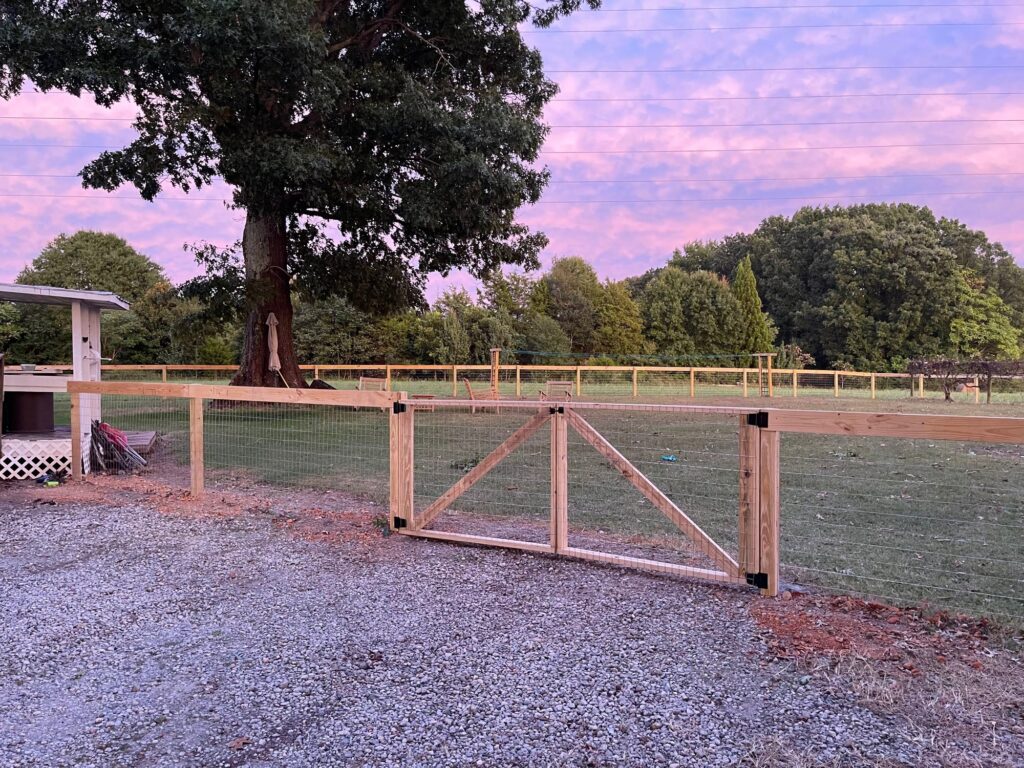
Two or three rails on open posts means almost nothing for wind to grab. Cedar or pressure-treated split rail rides out storms that flatten privacy fence next door, and it’s one of the more affordable installs ($18-24 per linear foot). It’s a boundary marker, not a privacy fence — but for acreage and back-lot lines, it’s the storm-smart choice.
Chain link: the quiet overachiever
Chain link is the most wind-transparent fence there is — that’s why you see it around ball fields and utility yards. It bends, it doesn’t break, and it’s the cheapest fence we install ($14-18 per linear foot). The fabric can sag after a direct hit, but posts rarely fail. Slats can be added for semi-privacy without losing much of the wind advantage.
Wood privacy fence: takes the hit and keeps standing
Wood privacy is what most people want, and here’s the field truth: a properly built wood fence outlasts vinyl in a North Carolina storm. When a big gust hits a wood panel, worst case you lose a board or two — the frame keeps standing and the fix is a board, not a whole panel. Build quality decides everything: deep posts, proper concrete, rot-resistant boards ($28-38 per linear foot installed).
Style matters as much as material. Shadow-box wood — boards staggered on both faces with air gaps between — is the best wind performer of the privacy styles, because pressure bleeds through instead of loading up the panel. Dog-eared and estate-style pickets come next: the open tops let gusts pass over. Solid board-on-board privacy catches the most wind of the three, so if your yard allows it, go shadow-box or picket and you’ll never miss the solid wall.
Vinyl privacy fence: looks clean until the first big gust
Vinyl handles moisture the way wood can’t — no rot, no warp. But vinyl is the fence we get storm service calls on: panels pop off the rails and crack in big gusts, and the material turns brittle after years of North Carolina UV. The panel-to-rail connection is the weak link, and a failed vinyl panel usually means replacing the whole section. Quality thick-gauge vinyl ($32-42 per linear foot) fares better — but in a straight fight with wind, wood wins.
Storm-proofing any fence: the four details that matter
Regardless of the style you pick, these are the details that decide whether your fence is standing after the next storm:
- Post depth. In North Carolina clay, posts belong 24-30 inches deep for a 6-foot fence — deeper than the national rule of thumb, because our freeze-thaw and clay heave demand it.
- Concrete, set right. Concrete collar with a crown above grade so water sheds away from the post, not into the hole.
- Wind gaps where you can. Shadow-gap and shadowbox designs let pressure bleed through the panel. A solid board-on-board wall is a sail; give it breathing room if privacy allows.
- Brace the gates. Gate posts take the most abuse. Oversize them and double-hinge.
Repairing storm damage: the honest math
A leaning fence is often salvageable — a few posts can be re-set and the panel re-strung for a fraction of replacement. A fence with snapped posts throughout is done; posts are the fence. After a storm, we’ll tell you which situation you’re in, with photos, before anyone talks money.
Get a real number, not a pitch
We don’t do sales calls. Run your fence line through our instant fence quote calculator for a price by style and length, see the full price sheet on our fence installation page, and see real jobs in our fence gallery, or compare the total cost of fencing in NC in our fence cost guide. Prefer to talk it through? Call 336-988-ROOF or grab a time on the calendar — you’ll talk to the owner, not a salesperson.
Frequently asked questions
What fence holds up best in high wind?
Fences that let wind pass through: aluminum, chain link, and split rail. For privacy, a properly built wood fence holds up better than vinyl — vinyl panels crack and pop off the rails when a big gust hits.
How deep should fence posts be in North Carolina clay?
24-30 inches for a 6-foot fence. NC clay swells when wet and shrinks when dry, so under-set posts work loose within a few years. Depth is the cheapest storm insurance in fencing.
Do I need to replace a fence that’s leaning after a storm?
Not necessarily. If the posts are intact and only a few leaned, they can usually be re-set and the fence straightened. Snapped or rotten posts throughout the line usually means replacement is the honest answer.
How much does wind-resistant fencing cost in NC?
In the Triad, chain link runs $14-18 per linear foot, split rail $18-24, wood privacy $28-38, aluminum $30-45, and vinyl $32-42. The full price sheet is on our fence page — no sales call required.
